Showing posts with label Ideas. Show all posts

Saturday, December 15, 2012

Letter of the Month?

Tuesday, December, 04, 2012 - 3:03:23 PM, Dundas Star News

Bone-headed design reduces safety

Robert Pinder, Dundas

Re: Tragedy on Governor’s Road

I don’t know any of the details of this tragedy, but I do know this area of Governor’s Road is a very densely populated residential one with hundreds of condos, apartments, a busy grocery store and even a retirement and long-term care facility. Add in a large church not too many metres from the intersection, the fact that this is a main route to two schools, and the picture is complete.

I also know that there is not one crosswalk along the 1.1-kilometre section of Governor’s Road between Ogilvie and Creighton. I will add further there are no left-turn lanes. However, absurdly, there is a third driving lane located on the westbound side of Governor’s, which allows for drivers, for some unfathomable reason, to greatly exceed the speed limit for 1.1 kilometres and pass those on the right lane, which they unquestionably do on a residential road in the town of Dundas.

This makes me very angry, not just for the poor casualty of this bone-headed road design, but for the safety of the thousands who use this daily. This is a terrible and deplorable “All Hail the Automobile” situation.

City roads designers, please get some crosswalks on that road — and other desolate lengths of city streets — today. Convert that preposterous middle lane into cycling lanes in either direction and left-turn lanes as needed.

Friday, August 22, 2008

fatality on Governor's at Ogilvie

Ongoing safety concerns plague Ogilvie intersection
89-year-old struck and killed crossing street last weekCraig Campbell, Dundas Star News.
Published on Aug 22, 2008

Pedestrian safety concerns about the intersection of Governor's Road and Ogilvie Street were raised at a Downtown Dundas Transportation Master Plan public meeting 10 weeks before 89-year-old Marjorie Rivers was struck and killed by a truck just west of the intersection.

City of Hamilton staff is reviewing several possible recommendations to improve safety for pedestrians at Ogilvie and Governor's, a busy area for residents of two high-rise apartment buildings and hundreds of seniors.

Hamilton police continue an investigation of the accident, which has already led to a careless driving charge against an unnamed 55-year-old Dundas man. A coroner's investigation also continues.

Advance left turns in up to four directions, road widening, a roundabout, and timing adjustments of pedestrian and traffic signals are among recommendations a city staff committee is reviewing. Project co-coordinator Natasha D'Souza said feasible recommendations will be brought to a fall public meeting. On June 5, the intersection was the subject of several public comments during a presentation on preliminary studies of transportation in the centre of Dundas.

Governor's and Ogilvie was one of only two Dundas intersections projected to be a problem in both low population growth and high population growth.

According to a summary of public comments from the meeting, "special attention" was requested for this particular intersection "because many seniors are crossing there." One resident reported a near accident at the intersection while traveling to the transportation meeting that very night. Another comment noted excessive traffic volumes at Governor's and Ogilvie and requested "pedestrian crossing provisions."

Mrs. Rivers was apparently returning home to her apartment in Governor's Estates at 50 Governor's Rd. after a shopping trip to the grocery store on the northeast corner of the busy intersection, about 11:35 a.m. on Thursday, Aug. 14.

She was struck by a Union Gas truck turning left onto Governor's Road from Ogilvie Street and proceeding westbound on Governor's away from Dundas. She suffered head and chest injuries. Some of her belongings remained scattered on the sidewalk, past the marked crosswalk.

Mrs. Rivers was taken by paramedics to Hamilton General Hospital, the destination for all adult trauma injuries. The trip took 11 minutes, passing McMaster University Medical Centre on the way, arriving at the hospital at 12:09 p.m. Hamilton Emergency Medical Services reported no delay in getting Mrs. Rivers to the trauma team.

Mrs. Rivers died the next afternoon. The cause of death has not been released.

For area residents, the dangers of walking in the area of Governor's Road and Ogilvie Street are well-known.

When he heard about Mrs. Rivers, Governor's Green apartment resident Andy Cranbury immediately thought it was an elderly woman in his building, at 101 Governor's Rd. who walks to the same grocery store nearly every day.

"We support a delayed (or) advanced light at Ogilvie because at certain times of the day, making left turns from any direction can be difficult," said Mr. Cranbury, a board member of the Governor's Green Tenant's Association.

He noted several threats to pedestrians in the area, particularly the many seniors who walk there.

"This area requires full attention regardless of whether you are walking or driving," he said. "...all the distractions for drivers and walkers, looking both ways, knowing you must move when the opening allows, not wanting to wait another light or two, adds to the danger.

"Walking and bicycle riding along these areas is a life-threatening venture at the best of times. In an era of encouragement of physical fitness, walking and biking, speed limits are not being lowered. I guess it's a matter of respect for one another for the laws of physics. You know, a vehicle doesn't have to be going very fast to inflict serious damage on a human body."

Safety problems

Dundas resident and transit activist Randy Kay discussed pedestrian safety problems at Governor's and Ogilvie last summer on his Governor's Road weblog.

At the time, Mr. Kay suggested wider sidewalks at Ogilvie and Governor's, noting the existing pedestrian walkways are too narrow, and only exist on one side of Ogilvie.

"And why aren't we talking about traffic calming here?" he wrote.

"Think boldly. Eliminate one bridge (on Ogilvie, north of Governor's) and open Spencer Creek to view. It would make the intersection more beautiful, not to mention safer."

Mr. Kay stated closing the bridge would eliminate some turning problems for vehicles trying to turn west onto Governor's from Ogilvie -- the same turn that ended in Mrs. Rivers' death last week.

He observed drivers attempting that maneuver "often aggressively turn to make the short green light."

Rod Aitchison of the City of Hamilton's traffic engineering department said there is no advance left turn signal in any direction at Governor's Road and Ogilvie. He said pedestrians are also permitted to cross on a green light, while traffic can turn left through their path.

"The timing of the pedestrian signal meets the required standards," Mr. Aitchison said. "The amount of time is tailored to the specific intersection."

He would not say how long drivers have to complete a left turn or how long pedestrians have to cross the street, and how those times compare to other intersections.

Mr. Kay, also a member of Transportation for Livable Communities, said the group opposes "so-called" roadway improvements that would include two-way left-turn lanes along Governor's Road and widening of Governor's Road.

He said the closure of Ogilvie Street north of Governor's Road is his own idea.

"It would allow the extension of a pedestrian area along Artist's Way right up to the creek at Governor's. With all the senior residences there, it would aid the elderly in accessing shopping in a safer environment."

Dr. Jack Stanborough, the regional supervising coroner, said all non-natural deaths are investigated by the coroner's office.

He said the decision to bypass the closest hospital at McMaster and take Mrs. Rivers to Hamilton General was the right one.

"If she was my mother, I would have wanted her triaged and treated the way she was," Dr. Jack Stanborough said.

He noted the pedestrian safety issues at the intersection, and also said the cause of Mrs. Rivers' death would not be released without consent from her next-of-kin.
http://www.dundasstarnews.com/news/article/140440

Sunday, April 01, 2007

Roundabout

Watch a live cam of the Ancaster Traffic Circle (in the city of Hamilton) - a similar roundabout is proposed for Governors Road at Huntingwood, which would be an effective way to calm traffic.

I'm fairly certain that the city has budgeted some money to bring this into reality.

It's "new" so it will likely frighten people at first, but it is actually safer in terms of lower collision rates, etc. than other intersection types.

Thursday, March 08, 2007

LITTLE BIT, WEST


A little bit west of Dundas, in Westdale, there have been a few minor traffic calming elements installed. This is one of them, a little traffic island on Forsyth. This is the kind of thing (pretty much) we're looking for on Governor's. (Better if it were a raised median though). Well done Ward One! More from that ward later...

Friday, January 19, 2007

Letter for Liveable Community

PO Box 19, 1280 Main Street West, Hamilton ON L8S 1C0
tlchamilton.blogspot.com
g-tlc@mcmaster.ca
905-525-9140 ext. 26026

Monday, December 18, 2006


Dear Councillor Powers,

Transportation for Liveable Communities (TLC) is a working group of the Ontario Public Interest Research Group (OPIRG) McMaster. TLC works to achieve balanced sustainable transportation solutions in the city of Hamilton.

We are writing to draw attention to the traffic situation on Governor’s Road in Dundas.

With the new Dundas West elementary school under construction on Governors Road at Bridlewood, there will be three schools (including Highland Secondary School and St. Bernadette’s elementary school) on this short stretch of highway (less than 1km).

The statement of a problem can make all the difference when seeking solutions. TLC is concerned that a solution you offered on your web site during the recent election campaign begins with the assumption that “traffic flow” is the problem on Governor’s Road, and offers road widening as a solution.

TLC feels that this is the wrong assumption and a desperately wrong conclusion.

The problem, as we see it, is traffic flows all too well the majority of the time on Governor’s, and that the speed of that flow puts school children and other pedestrians, cyclists and drivers at risk.

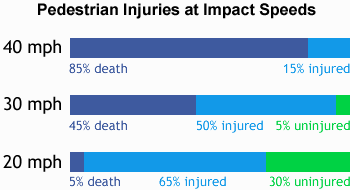
As you are likely aware there is a direct correlation between traffic speed and pedestrian fatalities:

Fig. 1 U.K. Department of Transportation, 1987. Killing Speed and Saving Lives, London, UK DOT.

Generally the only time traffic slows down on Governors is during “rush” hours, when the presence of too many single occupancy vehicles all going in the same direction at the same time creates a situation that is, from a pedestrian and cycling point of view, actually safer in terms of collision impacts. We should be aiming for a 30km/h maximum speed limit in the school zone.

TLC would thus prefer to pose the question: “what measures can be employed to create a safe and healthy environment for children using active methods of getting to school (i.e. cycling, walking) and to engineer a safer roadside environment for area residents outside of school hours?”

The City of Hamilton’s Public Health department recognizes the need for safe routes to school:

“Concerns about health and pedestrian safety among our children and air quality issues are prompting us to rethink the way we choose to get around in our communities,” said Sue Connell, Public Health Nurse with the City of Hamilton. “Obesity and inactivity in young children are reaching unprecedented levels and are creating serious health problems in our children. Vehicle transportation contributes to air pollution and smog and our children are especially vulnerable to the impacts of poor air quality. Many of the school zones in the Hamilton area are unsafe because of traffic concerns because large numbers of children are being transported to and from school. By walking to school with their parents or caregivers, children have an excellent opportunity to learn and develop their pedestrian skills.”

newsandpublications/newsreleases/ 2005news/september/05-09-30.htm

Road widening would only allow for increased vehicle speeds and make crossings more dangerous than the current situation, and run counter to the goals of the Transportation Master Plan currently under consideration by the city, and the goals outlined in Vision 2020:
  • To develop an integrated sustainable transportation system for people, goods and services which is environmentally friendly, affordable, efficient, convenient, safe and accessible.
  • To encourage a shift in personal lifestyle and behaviour towards transportation choices that enhance personal health and fitness, save money, and have the lowest environmental cost.

It is imperative that we get the necessary improvements in place as opportunity presents itself. And it is important that proper engineering is applied to ensure safe outcomes.

When slowing or ‘calming’ traffic, the right design invites the right driver response. The guiding principle of traffic calming is to influence motorist speeds and behavior through good design whenever possible, rather than by traffic control measures such as traffic signals and STOP signs.

There are many design and engineering tools that can be used to slow down traffic and make it safer for children to walk and bicycle to school including;
  • Narrow lanes
  • Chokers and chicanes
  • Speed humps
  • Raised pedestrian crosswalks
  • Neighborhood traffic circles
  • Reduced corner radiiSpeed sensitive signals
Source: http://www.saferoutesinfo.org/guide/engineering/slowing_down_traffic.cfm

Proper consideration must be given to effective traffic calming design if we are to be supportive of active modes of transportation like walking and cycling. Lane narrowing, the addition of bicycle lanes, wider sidewalks, a traffic median, a pedestrian crossing are all potential treatments that could enhance the safety of the school zone.

Surely the concentration of schools on this dangerous roadway makes safety considerations a priority for the city to address in a timely fashion.

TLC is happy to assist by being part of a public process that effectively deals with the worthy goals of providing safe and active routes to school, and improved cycling and walking facilities for area residents.

TLC would appreciate your prompt response and an outline/timeline of the next steps you intend to take.

We look forward to hearing from you in the near future.


Randy Kay

For Transportation for Liveable Communities

Tuesday, October 24, 2006

coasting

Still waiting for return calls/e-mails from city staff.

I have some updates on converstations with folks from Highland Secondary School, which I will post soon, as well as some new photos of the roadway.

I think rather than try and make all the suggestions about what needs to happen, I will coast a bit (like these local cyclists on Governors) while waiting to hear from city staff about what they think will make things safer for kids on this stretch of road.

Shouldn't that be their job? (and why we need to make sure it happens?)

Wednesday, October 18, 2006

No truck is a (traffic) island?


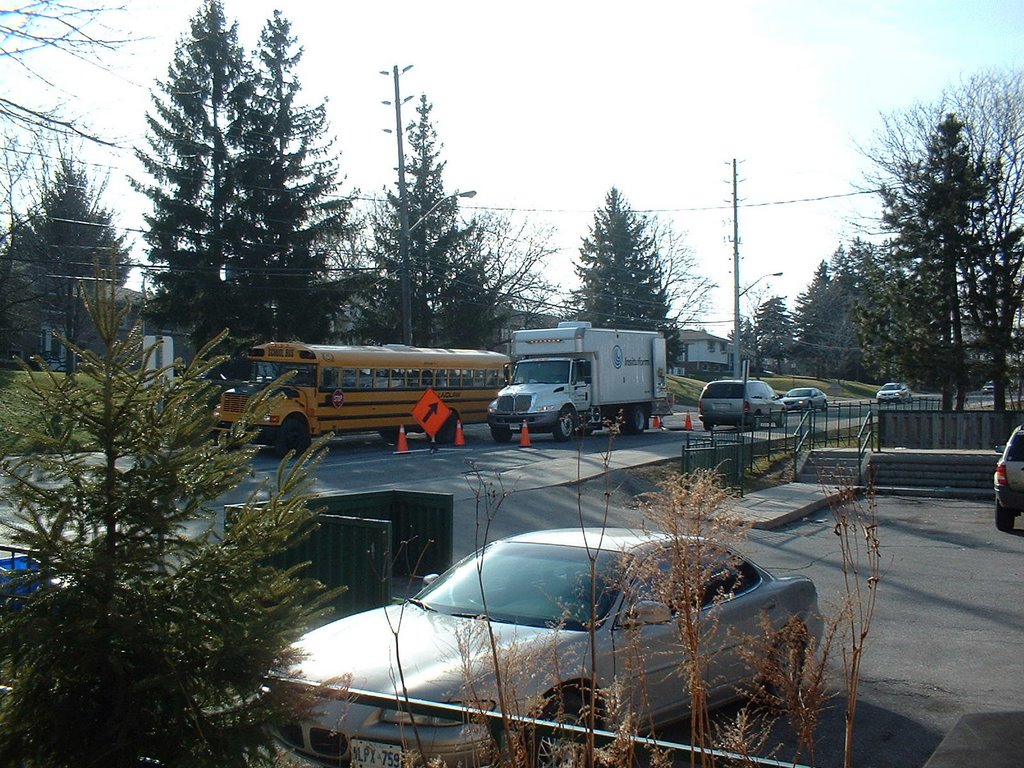
An experiment? Traffic flow was slowed by the presence of this work vehicle parked on the centre line of Governors Road (just west of Creighton) for several hours - the physical presence of the truck (and the warning signage) forced vehicles to proceed carefully. This same result could be achieved with a traffic median/island at this location as part of traffic calming measures to create safer pedestrian/cycling environments east of the school zone.

Tuesday, October 17, 2006

All flash, no action?

Because of this:

National Survey Reveals Nearly Two-Thirds of Drivers Speed in School Zones, Suggesting Neglect of Child Pedestrians Community Wide
(October 4, 2000) — According to a national survey released today by the National SAFE KIDS Campaign, the majority of motor vehicles in school zones exceed the speed limit. The prevalence of speeding around schools, where safety measures exist, suggests that drivers are even more neglectful in residential areas.
(Source: USA Safe Kids)


We need to consider this:

When slowing or ‘calming’ traffic, the right design invites the right driver response. The guiding principle of traffic calming is to influence motorist speeds and behavior through good design whenever possible, rather than by traffic control measures such as traffic signals and STOP signs.

There are many design and engineering tools that can be used to slow down traffic and make it safer for children to walk and bicycle to school including:

Narrow lanes
Chokers and chicanes
Speed humps
Raised pedestrian crosswalks
Neighborhood traffic circles
Reduced corner radii
Speed sensitive signals


(Source: SRTS)


because of this:


Let's not be distracted by flashing lights as a full response to safety for people walking and cycling to school. A further consideration: safety should transcend school hours to create full time security for residents of the area.

Saturday, October 14, 2006

Transit

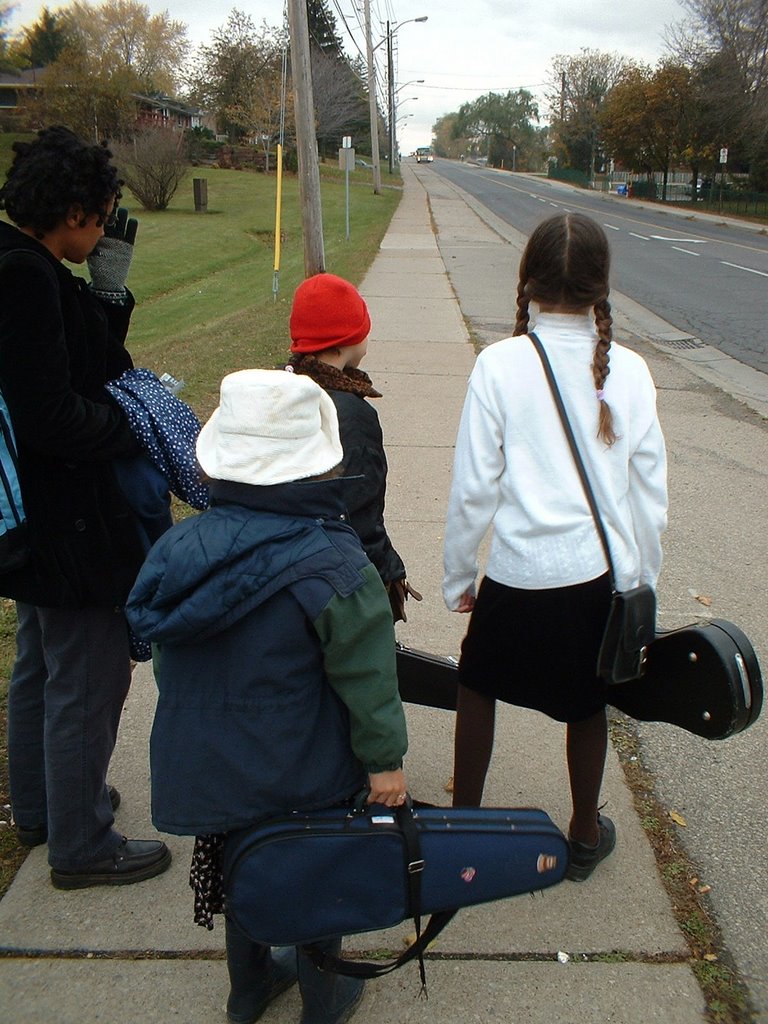
waiting for the bus looking west on Governors Road from bus stop at Creighton Road
Governor's Road gets bus service during weekday rush hour, then a bus once an hour at other times during the day, and no service after 10pm or so during the week. There is no bus service on Governors on weekends.

A further complication is the poor internal bus routing in Dundas - high school students wishing to take a city bus to school have no real direct service between the schools and where many of them live (ex. Downtown, York Road, Pleasant View).

If we want people to become less dependent on their cars we need to provide alternatives. Improved bus service, bicycle lanes and pleasant, safe walking routes combined with traffic calming can deliver. We just need to put things in place.

HSR Main Page